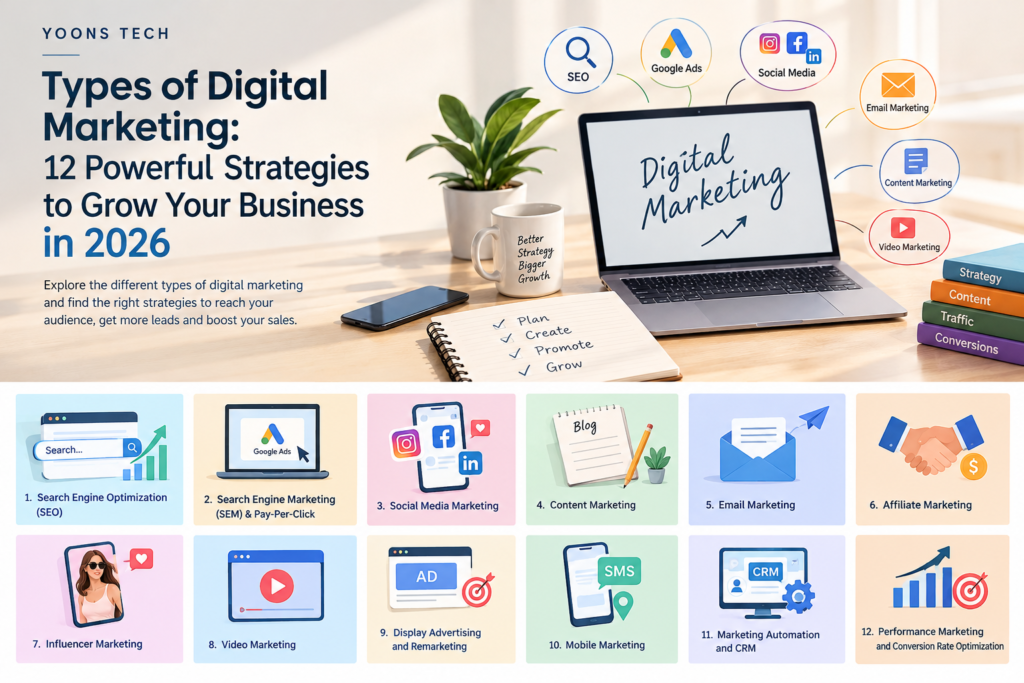
SEO Blog Writing Prompt: Types of Digital Marketing in 2026
1. Role and Expertise
Act as a senior SEO content strategist, digital marketing expert, and professional blog writer with 15+ years of experience in SEO, content marketing, keyword research, search intent optimization, and conversion-focused website content.
Write a high-quality, original, informative, and SEO-optimized blog for Yoons Tech, a digital marketing agency website: https://yoons.tech/.
The blog must educate business owners, entrepreneurs, startups, marketers, and beginners about the different types of digital marketing and help them understand which strategies can grow their businesses in 2026.
2. Blog Title
Types of Digital Marketing: 12 Powerful Strategies to Grow Your Business in 2026
Use this title as the H1 heading. You may optimize the SEO title slightly if necessary, while retaining the primary keyword and the year 2026.
3. Target Keywords and Keyword Frequency
Primary keyword
types of digital marketing
Use the exact primary keyword naturally at least 5–6 times throughout the blog. Include it in the H1, introduction, at least one relevant subheading, body content, and conclusion where appropriate.
Secondary keywords
types of online marketing
different types of digital marketing
types of digital marketing strategies
Use each secondary keyword naturally at least 3–4 times throughout the article. Distribute the keywords across relevant sections without forcing them into every paragraph.
Related semantic keywords
Naturally incorporate relevant variations, including:
digital marketing strategies for business growth
search engine optimization (SEO)
social media marketing
pay-per-click advertising (PPC)
content marketing
email marketing
affiliate marketing
influencer marketing
video marketing
mobile marketing
marketing automation
conversion rate optimization
online advertising
digital marketing trends in 2026
Avoid keyword stuffing, repetitive sentences, and unnatural keyword placement. Prioritize readability and search intent over arbitrary keyword density.
4. Reference Articles
Review the following reference articles to understand topic coverage, heading structure, content gaps, and relevant subtopics:
Use these references for research and inspiration only. Do not copy their sentences, paragraphs, structure verbatim, or unique expressions.
Create original content with additional practical examples, updated 2026 context, actionable recommendations, and a more useful explanation of each marketing type.
5. Target Audience
Write for:
Small and medium-sized business owners
Startups and entrepreneurs
Marketing students and beginners
Local businesses looking for online visibility
E-commerce brands
Companies seeking leads, sales, and brand awareness
Use simple, professional, conversational English that beginners can understand without sacrificing accuracy or expertise.
6. Word Count
Write between 800 and 1,200 words, including the introduction, all 12 strategies, conclusion, and FAQ section.
Keep paragraphs short, use descriptive subheadings, and remove unnecessary filler.
7. Required Blog Structure
H1: Types of Digital Marketing: 12 Powerful Strategies to Grow Your Business in 2026
Introduction
Introduce digital marketing and explain its importance in 2026.
Explain how online channels help businesses reach relevant audiences, generate leads, increase sales, and build brand awareness.
Include the primary keyword naturally within the opening paragraph.
Briefly explain what readers will learn from the 12 strategies.
Use an engaging hook without exaggerated claims.
H2: What Is Digital Marketing?
Define digital marketing in simple terms.
Explain how businesses use websites, search engines, social media, email, and paid advertising to connect with customers.
Briefly distinguish organic marketing from paid marketing.
Include the keyword “different types of digital marketing” naturally.
H2: 12 Types of Digital Marketing Strategies to Grow Your Business
Create an H3 heading for each of the following strategies. For each one, explain what it is, how it works, its main benefits, and one practical business example.
H3: 1. Search Engine Optimization (SEO)
Explain keyword research, on-page SEO, technical SEO, local SEO, and organic search visibility.
H3: 2. Content Marketing
Discuss blogs, guides, case studies, and educational content that attract and inform potential customers.
H3: 3. Social Media Marketing
Explain how Instagram, Facebook, LinkedIn, and other relevant platforms help brands engage audiences and build communities.
H3: 4. Pay-Per-Click Advertising (PPC)
Explain paid search advertising, Google Ads, keyword targeting, budget control, and measurable campaign performance.
H3: 5. Email Marketing
Cover newsletters, promotional campaigns, lead nurturing, segmentation, and personalized communication.
H3: 6. Affiliate Marketing
Explain how businesses collaborate with affiliates who promote products or services in exchange for commissions.
H3: 7. Influencer Marketing
Discuss working with relevant creators to increase reach, credibility, and audience engagement.
H3: 8. Video Marketing
Explain short-form videos, tutorials, product demonstrations, customer testimonials, and educational videos.
H3: 9. Mobile Marketing
Cover mobile-friendly websites, SMS campaigns, mobile advertising, and user experience on smartphones.
H3: 10. Display Advertising and Retargeting
Explain banner ads, audience targeting, and reconnecting with visitors who previously interacted with a website.
H3: 11. Marketing Automation
Discuss automated email sequences, lead follow-ups, customer segmentation, and repetitive marketing workflows.
H3: 12. Conversion Rate Optimization (CRO)
Explain how landing pages, calls to action, forms, and user experience improvements can help convert more visitors into leads or customers.
H2: How to Choose the Right Digital Marketing Strategy for Your Business
Explain how businesses should select the most appropriate channels based on:
Marketing goals and business objectives
Target audience and customer behavior
Available budget and resources
Product or service type
Competition and industry
Campaign performance and measurable results
Include practical guidance on combining SEO and content marketing for long-term growth with PPC and social media advertising for targeted reach.
Use the secondary keyword “types of online marketing” naturally in this section.
H2: Conclusion
Summarize the importance of choosing the right digital marketing channels instead of using every strategy at once. Reinforce that the best approach depends on business goals, audience, and budget.
Include the primary keyword naturally and end with a clear, helpful call to action inviting readers to explore Yoons Tech at https://yoons.tech/ for digital marketing services.
H2: Frequently Asked Questions (FAQs)
Include three concise FAQs:
What are the main types of digital marketing?
Which type of digital marketing is best for small businesses?
How can businesses choose the right digital marketing strategy in 2026?
Provide direct, accurate answers of approximately 30–50 words each. Incorporate relevant keywords naturally without repeating exact phrases unnecessarily.
8. On-Page SEO Requirements
Follow these on-page SEO practices:
Write a compelling SEO title of approximately 50–60 characters where practical.
Create a meta description of approximately 140–160 characters that summarizes the article and encourages clicks.
Use one clear H1 heading and a logical H2/H3 hierarchy.
Include the primary keyword naturally in the title, introduction, and relevant sections.
Distribute secondary and semantic keywords contextually.
Use short paragraphs, descriptive subheadings, and scannable lists where useful.
Add a suggested URL slug:
/types-of-digital-marketing/.Recommend descriptive image alt text that accurately describes each image.
Suggest relevant internal links to existing, appropriate pages on https://yoons.tech/.
Include the homepage link https://yoons.tech/ naturally in the conclusion or service call to action.
Suggest authoritative external sources where they substantiate factual claims.
Recommend relevant FAQ structured data only if the content and implementation meet current Google guidelines.
Ensure the content is mobile-friendly, useful, accessible, and easy to scan.
Do not invent internal URLs, client results, statistics, testimonials, awards, or guarantees. If additional website pages are needed, mark them as suggested links to verify before publishing.
9. Content Quality and E-E-A-T
Demonstrate experience, expertise, authoritativeness, and trustworthiness.
Explain concepts accurately and provide practical, realistic examples.
Keep 2026 references relevant and avoid unsupported predictions.
Do not promise guaranteed rankings, instant traffic, or fixed sales growth.
Avoid generic AI-style introductions, repetitive conclusions, and exaggerated marketing claims.
Do not fabricate research, statistics, citations, or business achievements.
Use original wording and provide information that helps readers make informed decisions.
10. Internal Linking Strategy
Use https://yoons.tech/ as the primary internal linking destination.
Add the homepage link naturally using a relevant branded or descriptive anchor text, such as “Yoons Tech” or “digital marketing services.”
If relevant service pages exist, recommend contextual links to SEO, social media marketing, Google Ads, or content marketing pages. Verify every destination URL before including it. Avoid excessive links and repetitive exact-match anchor text.
11. Final Output Format
Return the completed deliverable in this order:
SEO title
Meta description
Suggested URL slug
Primary and secondary keyword list
Complete 800–1,200-word SEO blog with H1, H2, H3, and FAQs
Suggested internal links and anchor texts
Suggested featured image concept and alt text
Final SEO quality checklist confirming keyword placement, heading structure, readability, internal linking, originality, and word count
Before finalizing, check that the primary keyword appears at least 5–6 times and each secondary keyword appears at least 3–4 times naturally. Count exact-match occurrences in the completed blog body, excluding the SEO checklist and keyword list. Do not sacrifice readability to meet keyword targets.
Generate the complete blog only after review